

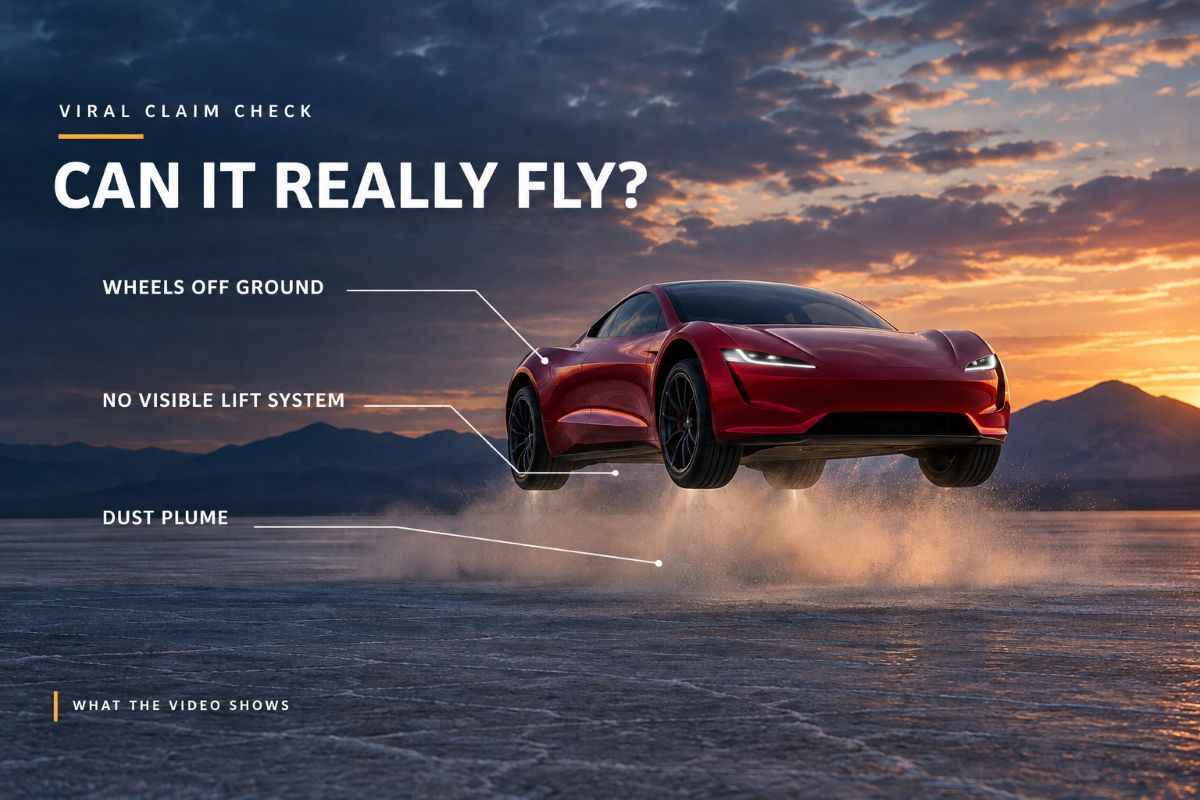
A car that appears to lift off the ground sounds like something from a science-fiction film, but a video linked to Tesla’s next-generation Roadster has reignited interest in the idea. The claim that the electric supercar can “fly” has caught the attention of technology enthusiasts, although there is an important distinction between a dramatic demonstration, a proposed feature and a production-ready vehicle.
For UK motorists, the bigger question is whether Tesla is developing a genuine flying car or pushing the boundaries of electric performance with an unconventional design.
What’s actually true about Tesla’s flying Roadster?

The video is based on a real demonstration. On 15 October, Tesla unveiled its redesigned next-generation Roadster at an event in Texas, where the car performed a series of extraordinary manoeuvres, including briefly lifting off the ground.
The technology behind the stunt is what makes the story unusual. Developed with involvement from SpaceX, the car uses cold-gas thrusters — systems that release compressed gas to generate thrust — rather than relying on conventional wheels alone for the airborne manoeuvre. A fan-based suction system was also demonstrated as part of the unusual upside-down driving sequence.
However, briefly lifting a car into the air is not the same as building a practical flying car. The demonstration does not establish that the Roadster can sustain flight, travel long distances through the air or safely navigate above ordinary traffic.
Tesla has also not demonstrated that these manoeuvres are suitable for everyday driving.
Could you buy or drive one in the UK?
That depends on which version eventually reaches production.
Reports following the unveiling describe different Roadster configurations, including a more specialised Rocket version with lift-off capability. The flying variant is not approved for public-road use, according to reporting by The Information.
For British buyers, that distinction matters. A vehicle can be technologically impressive without meeting the requirements for registration, roadworthiness, insurance and legal use on UK roads.
Tesla chief executive Elon Musk indicated that production is planned for 2028. That is a stated target, not confirmation that customer deliveries will begin on schedule. The project has already experienced years of delays since its original unveiling in 2017.
Three misconceptions the viral video may create
- It flies like an aeroplane. The footage shows a brief, controlled aerial manoeuvre, not sustained conventional flight.
- Every Roadster will fly. The lift-off capability is associated with the specialised Rocket version, rather than being established as a feature of every model.
- The technology is ready for public roads. The demonstration does not prove that the vehicle meets UK safety, regulatory or insurance requirements.
What should interested UK motorists do next?
If you are following the Roadster as a potential purchase, check Tesla’s official Roadster website for confirmed specifications, availability and reservation information. Treat performance claims and production targets as provisional until independently verified and supported by production vehicles.
Before considering a future purchase, UK buyers should also check the vehicle’s road-approval status and speak to an insurer about whether the specific model and its technology can be covered.
The bottom line
Tesla’s new Roadster has taken the flying-car conversation beyond a simple concept video, with a real demonstration of a car briefly leaving the ground. But it remains a major leap from a spectacular stunt to a practical, road-legal vehicle.
For now, the most important development is not that everyday cars are about to take flight. It is that Tesla and SpaceX are testing how rocket-style propulsion could change what a high-performance electric car can do.
