

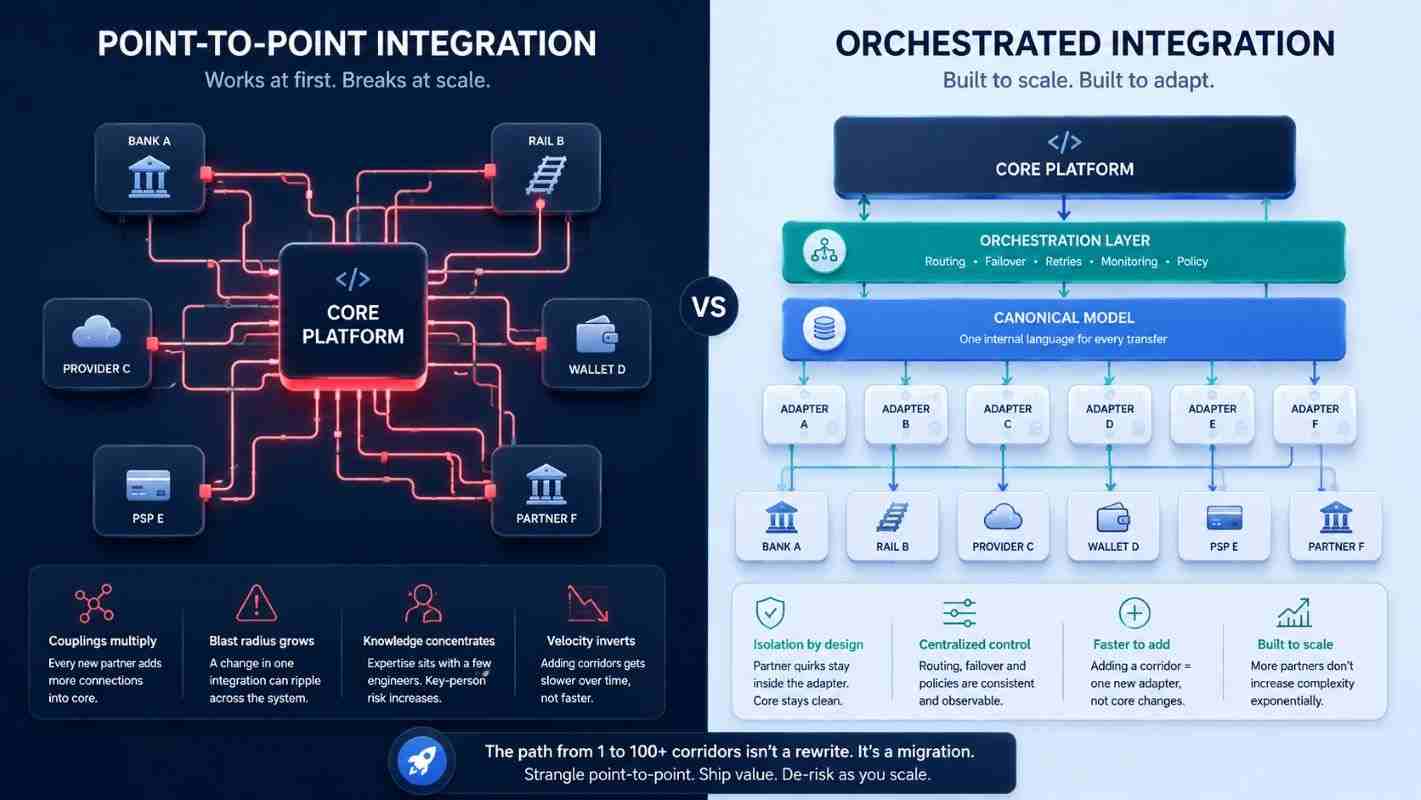
Learn when point-to-point integration becomes a scaling risk for payment platforms, and how fintech teams can migrate to orchestrated corridor architecture without a big-bang rewrite.
Point-to-point integration is often the fastest way to launch the first payment corridor, but it becomes a reliability and delivery risk as corridors, rails, and partners multiply. A canonical model can reduce transformation effort dramatically: six connected applications need 30 direct translators versus 12 with a canonical model. In Europe, instant payments require funds to be available in under 10 seconds, while ISO 20022 migration raises data-quality pressure. FreySoft helps fintech teams replace brittle direct wiring with orchestrated, corridor-ready payment architecture.
What point-to-point integration means in a payment platform
In a point-to-point integration model, every bank, payment rail, liquidity partner, payout provider, compliance service, or local scheme is wired directly into the core payment platform.
For the first corridor, this is usually the right decision. It is fast, pragmatic, and avoids building abstraction layers before the product has proven demand.
The problem appears later.
Each partner brings its own:
- API contract or file format;
- authentication method;
- payment status semantics;
- timeout and retry behaviour;
- reconciliation files;
- settlement timing;
- exception handling process;
- compliance and reporting requirements.
When these differences are embedded directly into core payment logic, the platform starts to behave less like a product and more like a collection of historical integration decisions.
Why point-to-point integration breaks as corridors grow
Point-to-point integration does not fail because it is “bad architecture.” It fails because its cost curve changes.
A useful way to think about this is the canonical data model pattern. Enterprise Integration Patterns explains that when six applications exchange messages directly, the system may require 30 direct translators; with a canonical model, it requires 12 transformations instead. The exact number in a payment platform depends on the topology, but the principle is the same: direct connections grow faster than governed abstractions.
In payments, this creates five practical problems.
1. Partner-specific logic leaks into core
A local payout partner may returnpending,
another may returnprocessing,
another may return no final status until a settlement report arrives. If those differences are handled inside core business logic, every new corridor increases the chance of state drift.
The platform no longer has one reliable definition of a payment lifecycle. It has many slightly different definitions hidden across the codebase.
2. Retry logic becomes dangerous
Retries are unavoidable in distributed payment systems. Networks fail, partner APIs time out, and settlement confirmations arrive late.
But retries are only safe when operations are idempotent. A retry should not accidentally create a second side effect when the first request may already have succeeded. In payment terms, that means avoiding duplicate debits, duplicate payouts, duplicate ledger entries, or inconsistent transaction states.
With point-to-point integration, retry behaviour is often re-implemented per partner. That increases the risk of inconsistent recovery logic.
3. Blast radius grows
When a partner changes a field, deprecates an endpoint, updates a status code, changes a signing method, or introduces a new settlement report, the change should affect only that partner’s adapter.
In a point-to-point model, the change often touches core flows. That makes regression testing slower and increases the risk that a local corridor update breaks an unrelated route.
4. Compliance work becomes harder to isolate
Payment systems increasingly need to support richer data, stronger fraud controls, and more explicit operational resilience.
For example, the ISO 20022 CBPR+ coexistence period for cross-border payments ended on 22 November 2025, increasing the importance of structured payment data and clean message translation. In Europe, the Instant Payments Regulation also introduces verification-of-payee obligations for standard and instant credit transfers.
If compliance checks, message enrichment, screening outcomes, and payee-verification results are scattered across direct integrations, auditability becomes harder.
5. Delivery velocity eventually inverts
At corridor #1, point-to-point is fast. At corridor #2, it may still be acceptable.
Around corridor #3 or #4, many teams begin to see the inflexion: adding a new corridor takes longer, not shorter. Engineers spend more time protecting existing flows than building the next one.
That is the signal that the integration model, not the team, has become the bottleneck.
Point-to-point integration vs orchestrated payment integration
| Area | Point-to-point integration | Orchestrated payment integration |
| First corridor | Fastest route to launch | Slower upfront |
| Additional corridors | Slower as complexity accumulates | Faster once the model is proven |
| Partner-specific logic | Often leaks into core | Isolated in adapters |
| Payment state | Fragmented across integrations | Governed through a shared state model |
| Retry handling | Rebuilt per partner | Centralized and idempotent |
| Routing and failover | Ad hoc | Policy-driven |
| Reconciliation | Partner-specific and inconsistent | Normalized into a common process |
| Compliance changes | Spread across flows | Localized through shared controls |
| Best fit | One or two stable corridors | Growing corridor, rail, and partner portfolios |
What orchestrated integration replaces it with
An orchestrated model introduces controlled separation between the payment core and external payment endpoints.
It usually has four layers.
1. Canonical payment model.
The core platform should speak one internal language for a payment.
A strong canonical model normally defines:
- payment identity and idempotency keys;
- sender, recipient, and account identifiers;
- amount, currency, fees, and FX details;
- payment method and rail;
- compliance and screening outcomes;
- payee-verification result;
- payment state and state-transition rules;
- settlement and reconciliation references;
- error codes and exception categories;
- metadata required for reporting and audit.
The goal is not to hide complexity. The goal is to put complexity in the right place.
2. Partner adapters
Each partner gets a bounded adapter that translates between the canonical model and the partner’s specific interface.
That adapter handles:
- request mapping;
- response mapping;
- authentication;
- partner-specific validation;
- status normalization;
- rate limits;
- retry constraints;
- reconciliation-file ingestion;
- partner-specific error translation.
Core payment logic should not know whether Partner A sayscompleted,
Partner B sayspaid,
and Partner C confirms success only in a settlement file. The adapter normalizes those differences.
3. Orchestration and routing layer
Above the adapters sits the orchestration layer.
This layer decides:
- which partner, rail, or route should process the transaction;
- when to retry;
- when not to retry;
- when to fail over;
- when to hold a payment for manual review;
- when to reverse, cancel, or compensate;
- how to expose a consistent payment status to internal systems and customers.
This is where commercial logic and reliability logic meet.
A payment operator may route based on cost, availability, currency, settlement speed, local coverage, compliance result, risk score, or partner performance. Without orchestration, those decisions become hard-coded into individual integrations.
4. Observability and reconciliation
A production-grade payment architecture also needs central visibility.
That means:
- transaction-level tracing;
- partner-level success and failure rates;
- timeout and retry metrics;
- stuck-payment detection;
- reconciliation breaks;
- settlement delays;
- manual operations queues;
- audit-ready state history.
This matters commercially because payment reliability is not only an engineering concern. Failed payments create support tickets, liquidity uncertainty, compliance exposure, and lost trust.
Why this matters more in modern payment infrastructure
The payment environment is becoming less forgiving.
Instant payment schemes raise availability expectations. The European Payments Council describes SEPA Instant Credit Transfer as making funds available in less than ten seconds at any time. The ECB also explains that instant payments make funds available within ten seconds of the payment order.
At the same time, payment data is becoming more structured. ISO 20022 migration means payment systems need better field mapping, stronger validation, richer remittance data, and cleaner exception handling.
Security and operational resilience are also part of the architecture decision. PCI DSS provides a global baseline of technical and operational requirements for protecting payment account data, while DORA has introduced harmonised ICT risk management requirements for many financial entities in the EU.
A brittle integration model makes all of this harder. An orchestrated model gives teams a controlled place to implement standards, monitoring, retries, audit trails, and partner-specific differences.
How to migrate without a big-bang rewrite
The main reason teams stay with point-to-point integration too long is fear of a rewrite.
That fear is rational. Big-bang rewrites in payments are risky because existing corridors still need to process live money movement, reconciliation, support cases, and compliance obligations.
The better approach is the strangler pattern: gradually route new functionality through the new architecture while the old system continues to run.
Step 1: Define the canonical model first
Do not start by rewriting adapters.
Start by defining the internal payment object, lifecycle states, error taxonomy, and reconciliation references. This is the contract that every future corridor must follow.
Step 2: Build the next corridor the new way
Do not migrate all existing corridors immediately.
Take the next new corridor and build it through the canonical model, adapter, and orchestration layer. This proves the architecture without disturbing existing volume.
Step 3: Put orchestration around one flow first
The orchestration layer does not need to control everything on day one.
It can start with one route, one rail, or one payout method. Once the pattern is proven, more flows can move behind it.
Step 4: Migrate old corridors opportunistically
Do not rewrite stable integrations just because they are old.
Migrate them when there is already a business reason to touch them, such as:
- partner API migration;
- ISO 20022 mapping changes;
- new compliance requirement;
- reconciliation redesign;
- poor reliability;
- new market expansion;
- cost optimization;
- support burden.
Each migration should reduce core coupling and retire one direct dependency.
Step 5: Move direct core dependencies last
The final step is not adapter creation. The final step is removing the old direct assumptions from core.
Only when enough traffic flows through the canonical layer should the team retire legacy code paths, old state mappings, and partner-specific exceptions embedded in the core platform.
When point-to-point integration is still the right choice
Point-to-point integration is not always wrong.
It is usually acceptable when:
- you are testing the first corridor;
- transaction volume is low;
- the partner set is stable;
- speed matters more than long-term flexibility;
- the business model is not yet proven;
- the integration is temporary;
- the team can tolerate manual reconciliation.
The mistake is not using point-to-point integration. The mistake is treating it as permanent infrastructure after the payment business has outgrown it.
When to move to orchestration
A fintech or payment operator should consider moving away from point-to-point integration when:
- each new corridor takes longer than the previous one;
- engineers are afraid to change old integrations;
- partner-specific logic appears inside core services;
- reconciliation depends on manual investigation;
- retry behaviour differs by partner;
- payment states are inconsistent across rails;
- compliance changes require edits in many places;
- support teams cannot explain transaction status confidently;
- one or two engineers are the only people who understand the integration map.
These are architecture symptoms, not just delivery problems.
The commercial case for fixing the architecture
The business case for orchestration is not “cleaner code.”
It is:
- faster corridor launch;
- lower regression risk;
- safer retries;
- more reliable reconciliation;
- fewer manual operations;
- clearer audit trails;
- stronger partner portability;
- better routing economics;
- reduced key-person risk;
- more predictable scaling.
For teams expanding across countries, currencies, rails, and payout methods, architecture becomes a growth constraint. If every corridor requires core changes, corridor expansion becomes slower exactly when the business needs it to accelerate.
For a broader view of how reliable corridors are engineered, see FreySoft’s guide to integrated payment solutions for reliable corridors.
For teams planning expansion, FreySoft also explains how fintechs actually add new payment corridors without treating each new market as a one-off project.
Absolutely. Here are five concise, SEO-friendly FAQs built around those two questions and the article’s main themes:
Frequently Asked Questions
1. What is a canonical payment model?
A canonical payment model is a standardised way of representing payment data and processes across different payment providers. It allows a business to work with multiple providers without building separate payment logic for each one.
2. When should you move away from point-to-point integration?
You should consider moving away from point-to-point integration when adding payment providers or new corridors becomes increasingly complex, integrations require frequent changes, or reconciliation, retries and payment-status handling become difficult to manage.
3. What are the main challenges of point-to-point payment integration?
Point-to-point integration can create tightly connected systems where each payment provider has its own API, rules and processes. As integrations grow, this can increase maintenance work, slow development and make changes more difficult.
4. How does payment orchestration improve integration?
Payment orchestration creates a layer between the core payment platform and external providers. This centralises routing, provider-specific integrations, monitoring and other processes, making it easier to add or change payment partners.
5. Can businesses move from point-to-point integration without rebuilding their entire payment platform?
Yes. Businesses can migrate gradually by introducing a canonical payment model, building adapters for new providers and moving individual payment flows to an orchestration layer. This reduces the risks associated with a complete system rewrite.
Conclusion: point-to-point is a launch shortcut, not a scaling strategy
Point-to-point integration is useful at the beginning because it gets the first corridor live quickly.
But as payment operators add rails, banking partners, payout methods, currencies, compliance checks, and reconciliation flows, direct integration becomes expensive to maintain. The system becomes harder to reason about, harder to test, and harder to change safely.
The better path is not a big-bang rewrite. It is a staged migration: define the canonical model, build the next corridor through adapters, introduce orchestration one route at a time, and gradually retire direct couplings.
FreySoft helps fintech and payment teams make that transition pragmatically: keeping live payment flows stable while building the architecture needed for corridor expansion, operational reliability, and long-term control.
