
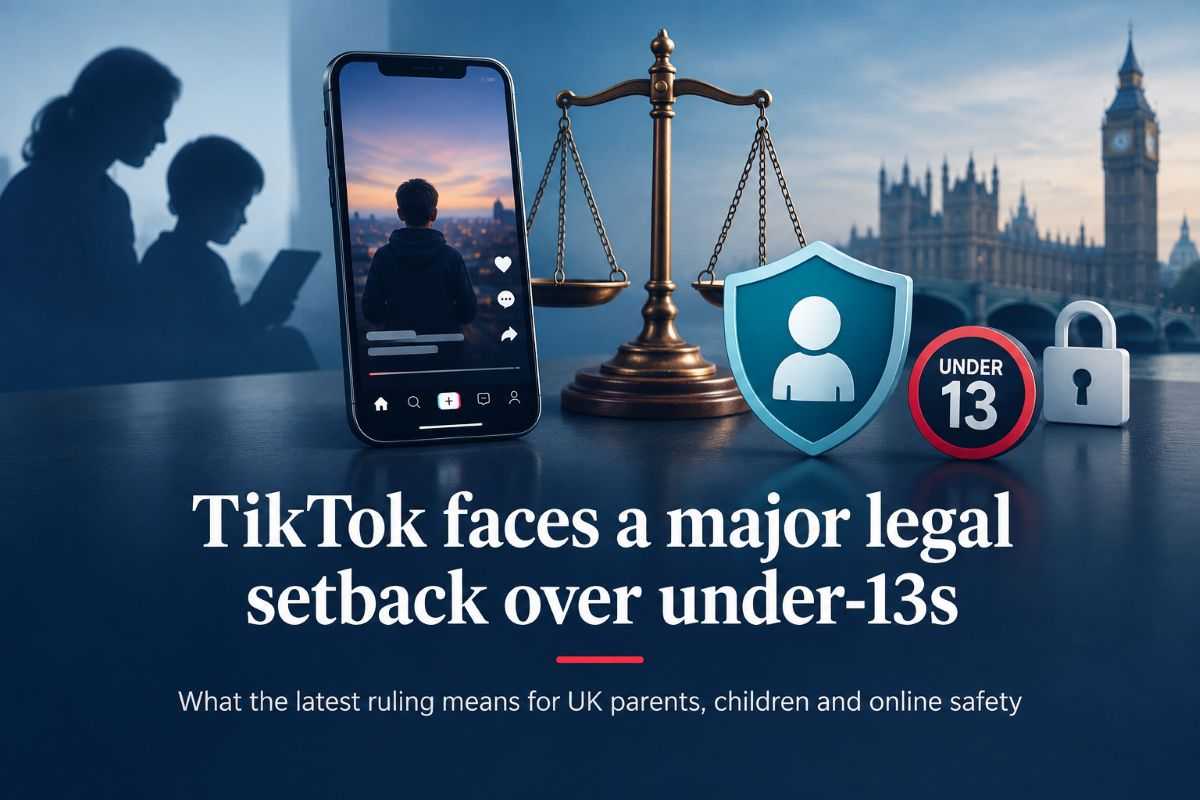
TikTok has ended its legal challenge against a £12.7 million UK privacy penalty linked to children under 13, bringing a long-running dispute with the Information Commissioner’s Office (ICO) to a significant point. But the development does not mean that every child under 13 will be suddenly blocked from TikTok overnight.
For parents, the bigger issue is how effectively social media platforms check users’ ages, what happens to children’s personal data and how this fits with the UK’s wider plans to restrict social media access for under-16s.
What’s actually true about TikTok and under-13s?
TikTok’s own minimum-age rules do not allow children under 13 to create an account. The ICO’s case centred on whether TikTok did enough to identify and remove children below that age and whether it handled their personal information lawfully.
The regulator said its investigation found that TikTok had failed to carry out adequate checks to identify and remove underage users. It also concluded that children were not given sufficiently clear information about how their personal data was collected and used, and that TikTok had not obtained parental consent where it should have.
The ICO estimated that as many as 1.75 million UK children under 13 had used TikTok in 2020, despite the platform’s minimum-age rules.
TikTok challenged the £12.7m penalty. In July 2026, however, the Upper Tribunal rejected a key argument from the company concerning whether its processing of personal data was covered by special protections for journalistic, artistic, academic or literary purposes.
Then, on 24 September, TikTok withdrew its appeal against the original penalty notice and agreed to pay the £12.7m fine. The penalty is therefore now final.
Why this matters beyond TikTok
The case is part of a much wider argument about age assurance — the methods platforms use to establish or estimate a user’s age.
The ICO has made clear that platforms which set a minimum age cannot simply rely on children telling the truth about how old they are. In March, the regulator called on major social media and video-sharing services to strengthen their age-assurance systems.
That could eventually mean more sophisticated checks rather than a simple date-of-birth box. Age assurance can include age verification, age estimation or parental confirmation, although the ICO says approaches should be proportionate and privacy-friendly.
There is another reason parents are likely to hear much more about this issue. The UK Government is developing plans to restrict social media access for under-16s. Its September 2026 fact sheet says the proposed model would cover platforms including TikTok, Instagram, Snapchat, Facebook and X.
That is a separate policy development from the ICO’s enforcement action against TikTok, so parents should not assume that the new plans are already the same as a current blanket ban.
Three common misconceptions parents should avoid
“TikTok is now automatically banned for every child under 13.”
Not as a direct result of this legal development. TikTok already sets a minimum age of 13, while the latest case concerns the company’s compliance with UK data protection obligations and its handling of underage users.
“The £12.7m fine means TikTok has admitted everything the ICO alleged.”
The situation is more nuanced. TikTok withdrew its appeals and accepted the penalty, following the tribunal’s decision on the preliminary legal issue. The regulator’s original findings explain the basis for the penalty.
“Parents can solve the problem simply by changing the child’s date of birth.”
That is not a reliable safeguard. The regulatory focus is increasingly on platforms using effective age-assurance measures rather than depending solely on self-declared ages.
What should parents do now?
If your child is under 13, check whether they have a TikTok account and make sure their age and account details are accurate. If they are using the service despite being below its minimum age, parents should consider removing the account rather than relying on an altered date of birth.
For teenagers, review privacy settings, who can contact them, what information is visible and how personalised recommendations work. The ICO is separately investigating TikTok’s use of the personal information of 13-to-17-year-olds in its recommender systems, so the regulatory focus extends beyond under-13 accounts.
Parents should also keep an eye on official announcements as the Government’s proposed under-16 social media restrictions develop. The precise rules and implementation arrangements may change before they come into force.
The bottom line
TikTok’s latest legal development strengthens the UK’s regulatory pressure on platforms to prevent underage children from using services that set minimum ages.
For parents, the immediate message is not that every under-13 TikTok account has suddenly disappeared. It is that age checks, children’s data and algorithmic recommendations are becoming much more closely scrutinised — and the rules governing young people’s social media use are continuing to change.
