

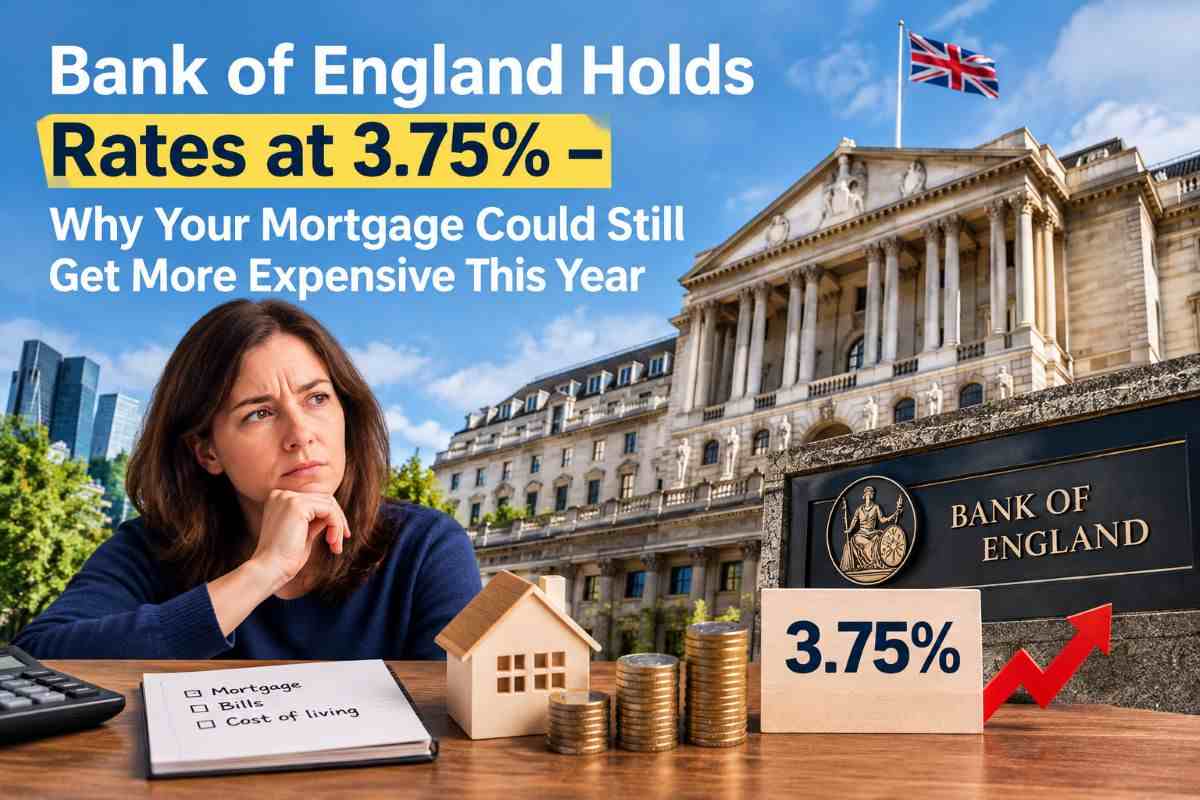
The Bank of England keeping interest rates at 3.75% might sound like welcome news for homeowners and anyone hoping to buy a property. But a pause in rate changes does not guarantee cheaper mortgages, and some borrowers could still face higher monthly repayments before the year ends.
The key question is why mortgage costs can rise even when the Bank holds its rate steady — and what homeowners can do now to prepare.
What’s actually true about the Bank of England’s decision?
The Bank of England’s Monetary Policy Committee (MPC) voted six to three to hold the Bank Rate at 3.75% on 17 September 2026. Three members wanted to raise it to 4%, reflecting concern that higher energy prices could keep inflation elevated.
The decision comes as UK inflation rose to 3.1% in August, above the Bank’s 2% target. The Bank has warned that energy prices linked to the conflict in the Middle East could push inflation higher in the coming months.
However, holding rates does not mean mortgage rates are frozen. Banks and building societies set mortgage prices using several factors, including their funding costs, financial market expectations and competition for borrowers.
Why your mortgage could still get more expensive
The key distinction is between the Bank Rate and the interest rate charged on your mortgage.
Fixed-rate mortgages are influenced by financial market expectations about future interest rates, particularly swap rates. These can rise before the Bank actually announces a rate increase.
The Bank’s September minutes noted that quoted two-year fixed mortgage rates were around 0.95 percentage points higher than before the Middle East conflict began.
That means lenders can increase the rates on new mortgage deals even while the Bank Rate remains unchanged.
For homeowners, the impact depends largely on their current mortgage arrangement:
- Fixed-rate mortgage: Your interest rate generally stays the same until the fixed period ends. A rise in new mortgage rates does not automatically change your monthly payment.
- Tracker mortgage: Your rate usually follows Bank Rate according to the terms of your deal. If Bank Rate rises, your repayments may rise too.
- Standard variable rate (SVR): Your lender sets this rate and can change it under the terms of your mortgage. It does not necessarily move in line with Bank Rate.
What happens if your fixed-rate deal ends this year?
This is where the latest decision becomes particularly relevant.
If your current fixed-rate mortgage expires in the coming months, you may need to refinance at a rate that is different from the one you currently pay.
Even if the Bank makes no further changes this year, lenders could adjust their available deals as financial market expectations change.
The effect on your household budget will depend on your outstanding mortgage balance, remaining term, new interest rate and repayment type. Some borrowers may face higher payments, while others could find deals that suit their circumstances.
The important point is that a Bank Rate hold is not a guarantee that your next mortgage deal will be cheaper.
Common mortgage misconceptions
“The Bank has held rates, so mortgage rates cannot rise.”
Not true. Fixed mortgage pricing responds to financial markets and lenders’ funding costs, not just the latest Bank Rate decision.
“If rates rise, every homeowner pays more immediately.”
Not necessarily. Someone with a fixed-rate deal will generally retain that rate until the deal expires, subject to their mortgage terms.
“Waiting for a Bank Rate cut is always the best strategy.”
There is no guarantee that rates will fall soon, or that lenders will reduce mortgage offers by the same amount. Waiting also means risking changes in the deals available when you need to refinance.
What should homeowners do next?
If your mortgage deal is due to end soon, start reviewing your options rather than waiting for the next Bank announcement.
- Check when your current deal expires and whether early repayment charges apply.
- Ask your existing lender what new deals are available, and compare them with other suitable options.
- Use a mortgage calculator to estimate repayments at different interest rates.
- Consider speaking to a qualified mortgage adviser, particularly if your circumstances have changed.
- Check the latest Bank Rate decision and mortgage information before committing to a new deal.
The next scheduled Bank of England rate decision is 5 November 2026. It could provide further information about the direction of monetary policy, but it cannot guarantee what mortgage lenders will charge.
The bottom line
The Bank of England’s decision to hold rates at 3.75% offers no automatic protection against higher mortgage costs. Lenders can change fixed mortgage offers as market expectations shift, while borrowers coming to the end of a deal may face a different rate from their current one.
For homeowners, checking the expiry date, comparing available deals and planning for different repayment scenarios are practical steps to take now.
